
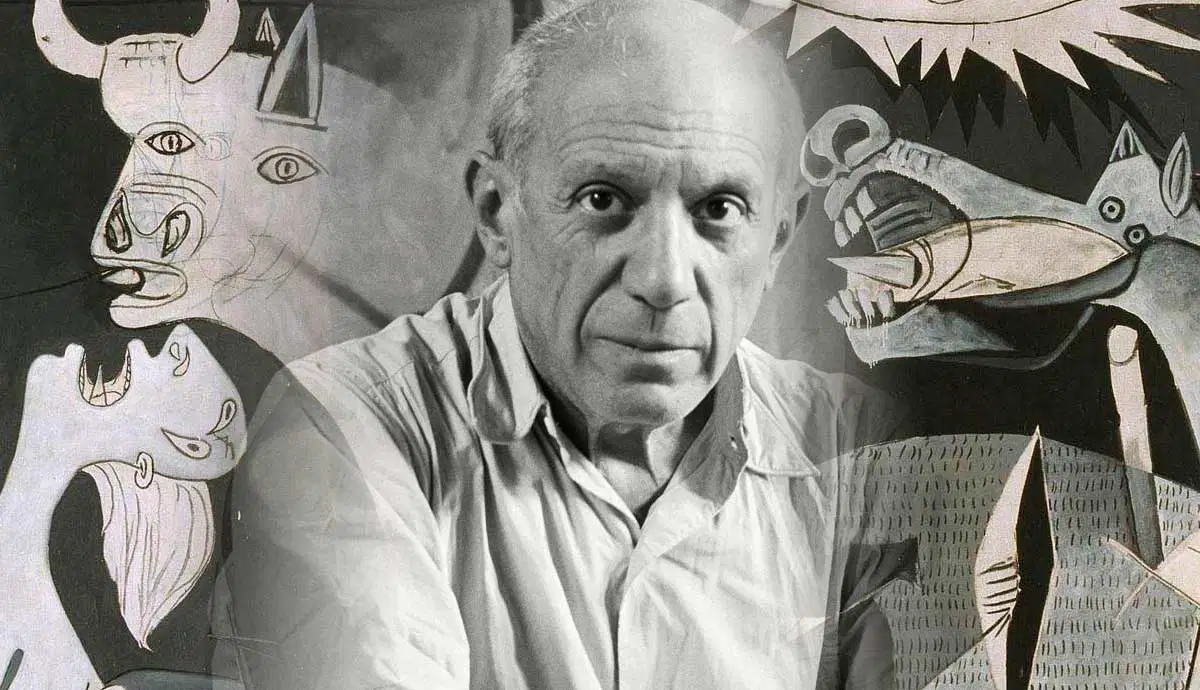
Pablo Picasso Guernica is one of the most famous paintings in modern art. Picasso created this huge artwork in 1937 after the bombing of Guernica during the Spanish Civil War. The painting shows fear, pain, confusion, and destruction. Instead of showing soldiers fighting on a normal battlefield, Picasso focused on people and animals caught in violence. This made the artwork emotional and powerful. Even today, people study Pablo Picasso Guernica to understand how art can tell the story of human suffering.
At first, Pablo Picasso Guernica may look confusing. The painting contains strange faces, broken bodies, animals, sharp shapes, and bright areas of light. However, every part helps create the mood of the artwork. Picasso did not try to make the scene look like a photograph. Instead, he changed normal shapes to show strong feelings. Therefore, viewers can feel the fear and sadness in the painting even without knowing every historical detail.
The artwork also became much more than a response to one bombing. Over time, it became a symbol connected with the suffering caused by war. Students learn about it in art classes. Historians discuss its connection with the Spanish Civil War. Artists study its unusual style. Visitors also travel to see it because of its size and historical importance. Pablo Picasso Guernica continues to show how one painting can carry a powerful message for many generations.
Who Was Pablo Picasso?
Pablo Picasso was a Spanish artist who became one of the most important artists of the twentieth century. He was born in Málaga, Spain, in 1881. His father was an artist and art teacher, so Picasso grew up around art. He started drawing at a very young age. His early talent became clear as he practiced and studied different forms of art.
Picasso did not use only one style during his career. Instead, he constantly experimented with new ideas. He painted people, animals, landscapes, objects, and scenes from everyday life. He also created sculptures, drawings, prints, ceramics, and other artworks. His long career allowed him to explore many different ways of expressing ideas.
Picasso also helped develop Cubism with Georges Braque. Cubist artists broke objects into simple shapes and sometimes showed different views at the same time. This changed traditional ideas about painting. Picasso later explored many other styles. His ability to experiment helped make him a major figure in modern art.
Because of this long and varied career, Picasso created thousands of works. Some look cheerful and colorful. Others look strange, serious, or emotional. Pablo Picasso Guernica belongs among his most serious works because it deals with violence, fear, and human suffering.
What Is Pablo Picasso Guernica?
Pablo Picasso Guernica is a large oil painting completed in 1937. The artwork measures about 3.49 meters high and 7.77 meters wide. Its huge size makes it very different from an ordinary painting. When people see it in person, the large canvas can make the figures feel even more powerful.
The painting uses black, white, and gray tones. Picasso did not fill the final artwork with bright colors. Instead, he used a limited range of tones to create a serious mood. The colors also give the painting a connection to newspaper photographs and reports about the bombing.
Several important figures appear throughout the artwork. Viewers can see a bull, a horse, a crying mother, a fallen figure, and other people. There are also lamps, flames, broken bodies, and unusual shapes. These parts overlap and create a crowded scene.
The painting does not tell a simple story from left to right. There is no single character explaining what happened. Instead, viewers must look carefully at the entire composition. This is one reason Pablo Picasso Guernica has remained interesting for so many years.
The Story Behind Pablo Picasso Guernica
The story of Pablo Picasso Guernica connects closely with the Spanish Civil War. The conflict began in 1936 and involved the Spanish Republican government and forces led by General Francisco Franco. The war became violent and attracted support from other countries.
On April 26, 1937, Guernica, a town in northern Spain, suffered a major air attack. German and Italian aircraft supporting Franco’s side took part in the attack. The bombing caused deaths, injuries, fires, and widespread destruction. News of the event soon spread through newspapers and photographs.
Picasso learned about the attack while working on a large artwork for the Spanish Pavilion at the 1937 Paris International Exposition. Reports of the destruction gave him a subject that deeply connected with the events of the time. He began developing a painting based on suffering and destruction.
Picasso created many studies before finishing the final artwork. He moved figures around and changed their shapes. Photographs of his working process show that he continued making changes. Eventually, the finished painting became known as Pablo Picasso Guernica.
Why Did Picasso Paint Guernica?
The Spanish Republican government invited Picasso to create a major artwork for its pavilion at the 1937 Paris International Exposition. Picasso accepted the project, but he initially struggled to decide what subject would work best. The bombing of Guernica changed his direction.
The attack gave Picasso a powerful subject. He could use the painting to respond to an event that had shocked many people. Rather than showing military equipment or a traditional battle, he focused on pain and destruction.
Picasso began with sketches and drawings. He explored different arrangements before deciding on the final composition. Some early studies look different from the finished painting. This shows how artists can develop an idea through many stages.
The finished work became a major part of the Spanish Pavilion. It attracted attention because of its huge size and unusual style. Pablo Picasso Guernica quickly became closely connected with the suffering caused by the war.
The Meaning of Pablo Picasso Guernica
The meaning of Pablo Picasso Guernica has been discussed by art historians for many years. The painting clearly shows suffering, fear, destruction, and confusion. However, Picasso did not provide one simple explanation for every figure and symbol.
This is important because people sometimes look for one exact answer. Yet, art can have several layers of meaning. One person may notice the crying mother first. Another may focus on the horse. Someone else may notice the broken soldier or the bright lamp.
Many interpretations connect the figures with the pain caused by war. The mother and child can remind viewers of families affected by violence. The wounded horse can suggest suffering. The fallen figure can suggest death and defeat.
However, viewers should separate historical facts from later interpretations. Some meanings come from art historians rather than direct statements from Picasso. Therefore, Pablo Picasso Guernica remains open to discussion.
The Horse in Pablo Picasso Guernica
The horse is one of the largest and most noticeable figures in Pablo Picasso Guernica. It stands near the center of the composition. Its body stretches across the scene and helps connect several other figures.
The horse looks wounded and frightened. Its mouth opens widely, and its body twists in an unnatural position. These details make the animal look as if it is crying out in pain.
Many viewers connect the horse with innocent suffering. The animal seems caught in the destruction around it. Its position also makes it one of the first figures that many people notice.
The horse has also received many different interpretations from art historians. There is no single simple explanation that answers every question about it. This uncertainty is part of what makes the painting interesting.
The Bull in Pablo Picasso Guernica
A large bull appears on the left side of the painting. Its head faces toward the viewer, while its body remains relatively still compared with some of the other figures.
The bull has attracted many interpretations. Some people connect it with Spain and Spanish culture. Others believe it may represent strength, darkness, or another idea. Picasso used bulls in many other works, which makes the symbol especially interesting.
The bull also creates a strong contrast with the horse. The horse looks frightened and injured, while the bull appears more controlled. This difference adds tension to the composition.
However, viewers should avoid treating one interpretation as the only correct answer. Pablo Picasso Guernica contains many symbols that have been discussed in different ways. The painting encourages careful observation rather than one quick answer.
The Crying Mother and Child
One of the most emotional images appears on the left side of Pablo Picasso Guernica. A mother holds her child while looking upward. Her face shows intense pain, and her open mouth makes her grief easy to notice.
The mother and child can remind viewers of families affected by war. Children do not choose wars, yet they can suffer from them. Parents can also lose their homes, safety, and loved ones.
Picasso used this image to create an emotional connection. Instead of showing only buildings and military action, he showed a personal moment of loss.
This figure is one reason the painting feels human. Viewers can understand the sadness even without knowing the complete history of the Spanish Civil War.
The Broken Soldier
Near the bottom of the painting, a fallen figure lies on the ground. His body appears broken into separate pieces. One of his hands holds a broken sword.
The broken sword can suggest defeat or the destruction caused by violence. A small flower appears nearby, creating an interesting contrast with the broken body.
Some viewers interpret the flower as a possible sign of hope. Others simply see it as another small detail within the chaotic scene. Picasso did not provide a simple explanation that settles every interpretation.
The fallen figure adds another important idea to Pablo Picasso Guernica. War can destroy individual human lives. The painting does not focus only on large events. It also shows the personal cost of violence.
The Lights in Pablo Picasso Guernica
Light is another important feature of the painting. A bright lamp appears near the top of the composition. Another light source appears closer to the center.
These lights attract attention because they stand out against the dark background. They also help guide the viewer’s eyes around the artwork.
People have offered different ideas about what the lights mean. Some connect them with modern technology. Others see them as symbols of awareness or observation.
The lights also create an interesting contrast. Light usually helps people see clearly. Yet, the scene remains confusing and frightening. This contrast adds another layer to Pablo Picasso Guernica.
Why Is Pablo Picasso Guernica Black and White?
Color can change the feeling of a painting. Bright colors can make an artwork feel cheerful, warm, or energetic. Picasso chose something very different for Guernica. He used black, white, and gray.
This limited color range creates a serious mood. It also makes the figures and shapes stand out. The viewer focuses on faces, bodies, movement, and expressions instead of colorful details.
The colors may also connect with the way people experienced news at the time. Newspaper photographs often appeared in black and white. Picasso had seen images and reports about the destruction of Guernica.
As a result, the color scheme strengthens the historical feeling of the artwork. Pablo Picasso Guernica looks like a visual record, even though Picasso did not paint the bombing as a realistic scene.
The Role of Cubism in the Painting
Picasso’s Cubist ideas influenced the appearance of Guernica. Cubism often breaks objects into geometric forms. It can show several views of something at once.
In Pablo Picasso Guernica, faces and bodies appear twisted and broken. The figures do not have normal proportions. Their shapes overlap and change direction.
This style helps communicate emotion. A realistic painting might show what a person looked like. Picasso wanted to show how frightening the situation felt.
The unusual forms also make viewers stop and look carefully. Instead of quickly understanding the scene, people must study it. This gives the artwork a strong visual impact.
The Importance of Size
The huge size of Pablo Picasso Guernica is important. The artwork is much larger than an ordinary home painting. Its size allows Picasso to fill the entire visual field with figures and movement.
When viewers stand in front of such a large artwork, they can feel surrounded by the scene. The figures become difficult to ignore.
The size also made the painting suitable for a large public exhibition. Visitors at the 1937 Paris International Exposition could see it from a distance.
Therefore, the physical size is not just a technical detail. It contributes to how people experience the painting.
Pablo Picasso Guernica and the Spanish Civil War
Pablo Picasso Guernica cannot be separated completely from the Spanish Civil War. The painting came from a specific historical moment.
The war divided Spain and created enormous suffering. It also became connected with wider international conflicts because foreign powers supported different sides.
The bombing of Guernica became especially well known because it showed the destructive potential of air attacks on towns and civilians.
Picasso responded to this history through visual art. He did not create a traditional history painting. Instead, he created an emotional image of destruction.
Where Was Guernica First Shown?
Pablo Picasso Guernica was first displayed at the Spanish Pavilion during the 1937 Paris International Exposition. The exhibition brought together architecture, art, technology, and cultural displays from different countries.
The Spanish Pavilion presented material connected with the Republican government during the civil war. Picasso’s huge painting became one of its major artworks.
After the exhibition, the painting traveled to different locations. It later became an important part of exhibitions connected with the Spanish Republican cause.
Its journey helped spread its message to audiences outside Spain.
Where Is Pablo Picasso Guernica Today?
Pablo Picasso Guernica is now displayed at the Museo Nacional Centro de Arte Reina Sofía in Madrid, Spain. The museum is one of the country’s major modern and contemporary art museums.
The painting arrived at the museum in 1992. Before that, it had spent many years outside Spain.
Visitors can see the enormous artwork in person. Seeing it directly can feel very different from looking at a small image on a computer screen.
The museum also displays related studies and works that help visitors understand Picasso’s creative process.
Why Is Guernica Important?
Pablo Picasso Guernica is important for both artistic and historical reasons. Artistically, it shows how Picasso used modern techniques to communicate emotion.
Historically, it connects with one of the most important conflicts in twentieth-century Spain. The painting also became known internationally as an image associated with the suffering caused by war.
Its importance does not come from realistic detail. Picasso did not try to document every part of the bombing. Instead, he created an emotional response.
That approach helped the painting reach people who may not know every detail of Spanish history.
What Can Students Learn From Pablo Picasso Guernica?
Students can learn many things from Pablo Picasso Guernica. First, they can learn about the Spanish Civil War and the bombing of Guernica.
Second, they can learn about modern art. The painting provides a strong example of how artists can use shapes and forms instead of realistic images.
Third, students can learn how art can communicate emotions. A painting does not always need words to tell a story.
Students can also learn that one artwork may have many interpretations. They can look at the same figure and ask different questions about its possible meaning.
How to Look at Pablo Picasso Guernica
When looking at the painting, it helps to take your time. Do not try to understand everything in a few seconds. Start by looking at the overall composition.
Next, focus on individual figures. Look at the horse, bull, mother, child, fallen figure, and lights. Notice their expressions and body positions.
Then, look at the shapes and lines. Notice how Picasso uses sharp angles and overlapping forms. These details create movement and confusion.
Finally, think about the historical background. Knowing about the bombing can help you understand why the painting carries such a serious mood.
Pablo Picasso Guernica and Its Message About War
One major reason the painting remains famous is its connection with war. Picasso did not present war as something exciting or heroic. Instead, he showed its destructive effects.
The people in the painting do not appear powerful. They look frightened, injured, or overwhelmed. The animals also appear caught in the chaos.
This makes the painting different from many traditional paintings about battles. Traditional battle paintings sometimes focus on victories or famous leaders. Pablo Picasso Guernica focuses on suffering.
That difference helps explain why the artwork continues to attract attention. Its central emotional message can be understood even by people who know little about art.
Pablo Picasso Guernica in Popular Culture
The influence of Pablo Picasso Guernica can be seen beyond museums and classrooms. Images inspired by the painting have appeared in books, documentaries, exhibitions, posters, and educational materials.
Its strong black-and-white design makes it easy to recognize. The horse, bull, and crying mother have become especially familiar images.
Artists have also studied Picasso’s approach when creating their own work about conflict and suffering.
The painting has therefore become part of a larger visual language. People can recognize its influence even when they do not know every detail of its history.
Common Misunderstandings About Guernica
One common misunderstanding is that Pablo Picasso Guernica is a realistic picture of the bombing. It is not. Picasso used an abstract and Cubist-inspired style.
Another misunderstanding is that every symbol has one officially confirmed meaning. Picasso did not provide a complete explanation for every figure.
Some people also assume that the painting uses only one style. In reality, it combines several artistic ideas and influences.
Understanding these points makes the artwork easier to appreciate. Instead of searching for one answer, viewers can study the painting as a complex visual response to violence.
Why Is Pablo Picasso Guernica Still Famous?
Pablo Picasso Guernica remains famous because it combines history, art, and emotion. It tells us about a particular event while also presenting a broader image of suffering.
The painting is also easy to recognize. Its huge size, black-and-white colors, unusual figures, and dramatic composition give it a unique appearance.
Furthermore, its subject remains relevant to discussions about war and peace. People continue to study how artists respond to difficult events.
Most importantly, the painting encourages questions. Viewers can ask what each figure means, why Picasso used certain shapes, and how the artwork makes them feel.
FAQs
1. What is Pablo Picasso Guernica?
Pablo Picasso Guernica is a large oil painting created by Pablo Picasso in 1937. It responds to the bombing of Guernica during the Spanish Civil War.
2. Why did Picasso paint Guernica?
Picasso created the painting after learning about the bombing of Guernica. He also created it for the Spanish Pavilion at the 1937 Paris International Exposition.
3. What colors are used in Guernica?
The painting mainly uses black, white, and gray. Picasso avoided bright colors, which helped create its serious and dramatic mood.
4. What does the horse represent?
The horse has received many interpretations. Many viewers connect it with suffering. However, Picasso did not provide one simple official meaning for every symbol.
5. Where is Guernica now?
Pablo Picasso Guernica is displayed at the Museo Nacional Centro de Arte Reina Sofía in Madrid, Spain.
Conclusion
Pablo Picasso Guernica remains one of the most important paintings of modern art. Picasso created it during a difficult period in Spanish history. The bombing of Guernica inspired the work, but the painting became much larger than that single event.
Its strange shapes, black-and-white colors, crying figures, horse, bull, and broken soldier create a powerful visual experience. Picasso used these elements to communicate fear, pain, and destruction without creating a traditional battlefield scene.
Today, Pablo Picasso Guernica continues to attract students, artists, historians, and museum visitors. Its history helps us understand the Spanish Civil War, while its artistic style shows how modern artists can communicate powerful ideas through unusual forms.
The painting also reminds us that art can preserve memories. A historical event may happen in one place and one period, but a powerful artwork can help later generations remember it. That lasting connection is one reason Pablo Picasso Guernica remains so widely studied today.
